Build, optimize and deploy at industrial scale

The OS and CUDA for
Quantum-AI-HPC

TensorCircuit-NG unifies quantum circuits, tensor networks, machine learning backends, QPU access, and HPC execution into one programmable substrate for simulation, QML, and quantum many-body physics.

1M+
PyPI Downloads
600+
Simulated Qubits
106x
Simulation Speedup
170+
Published Citations
Compile intelligence into quantum-scale compute
auto-diff
vmap / jit
tensor networks
agent workflows
Intent Layer
AI agent, scientist, enterprise pipeline
TC-NG Compiler
Circuit IR, gradients, contraction planning, backend staging
Unified Engine
Quantum circuits + tensor networks + ML frameworks in one graph
Compute Substrate
GPU, TPU, multi-node HPC, and QPU execution paths
Vertical Outputs
Chemistry, QML, optimization, many-body physics
agent_run.tcng compiled
>parse quantum workflow
>stage differentiable circuit graph
>search tensor contraction path
>dispatch batched gradients to GPU/HPC
>return verified benchmark artifact
compute fabric orchestrated
TC-NG
GPU
QPU
TPU
HPC
AD
TN

Unified. Scalable. Autonomous.

A holistic engineering architecture designed from the ground up to unify quantum compilation, high-performance computing, and agentic machine learning workflows.

Unified Engine

  • Quantum Circuits Differentiable ideal, noisy, stabilizer, and qudit circuit models.
  • Tensor Networks MPS, MPO representations, and customized contraction path finding.
  • AI Models Native layers and interfaces integrated into JAX, TensorFlow, and PyTorch.
  • Physical Simulations Pulse-level analog simulation and exact solvers (Krylov/Trotter/ODE).

HPC Substrate

  • GPU Acceleration Accelerated linear algebra kernels via NVIDIA CUDA.
  • TPU Acceleration Compilation to TPU matrix multiplication units using Google JAX XLA.
  • HPC Orchestration Distributed, multi-node, multi-GPU parallel circuit evaluations.
  • Hardware Agnostic Backend-agnostic design, writing code once to execute across heterogeneous chips.

Autonomous R&D

  • AI Coding Agents Standardized AGENTS.md rulesets, providing memory, skills, and tools for AI IDEs.
  • LLM Optimization Intent-driven translation and automated generation of quantum algorithms.
  • Auto-Optimization Autonomous searching of contraction paths and quantum circuit architectures.
  • Performance Squeezing Automatic staging and vectorization of quantum parameters on target backends.

The Five Pillars of Technical Maturity

How to distinguish an enterprise-grade platform from mere concept wrappers. TensorCircuit-NG delivers verified performance, peer-reviewed science, and commercial production readiness.

1. Open Source Ecosystem

Proven community trust and distribution

2. Public Benchmarks

Independently verifiable speedups

3. Academic Integration

Backed by elite global institutions

4. Commercial Verticals

Real-world pipelines in active trials

5. Continuous Evolution

6+ years of architecture refinement

Open Source & Production Ready

Star count > 500 | Contributions > 30 Authors | 1,000,000+ Installs

For scientific infrastructure, open source means code auditability, reproducibility, and local deployment options without proprietary lock-in.

  • 70,000+ Lines of Production-Grade Code: Complemented by rigorous CI/CD, type comments, and extensive unit testing.
  • AI-Native Ecosystem Integration: Equipped with structured schemas and metadata to allow AI Coding Agents to autonomously draft, optimize, and execute quantum algorithms.
  • 1,000,000+ Downloads on PyPI: Demonstrates wide deployment across active developer setups and corporate CI pipelines.

Rigorous Performance Metrics

Quantum 2023 | arXiv 2026 | GitHub discussions #116-#118

Benchmark claims are tied to specific workloads, hardware, precision, and source scripts rather than mixed into a single universal speedup number.

  • Published Benchmarks: The Quantum 2023 whitepaper reports value-and-gradient timings for TFIM VQE, QML, barren-plateau, QFI, and large 1D VQE workloads.
  • Current Comparisons: Discussions #116-#118 report post-compilation VQE value-and-gradient comparisons against PyTorch/TorchQuantum, MindQuantum, and cuQuantum with source scripts.
  • Scale Boundary: The original whitepaper reports a 600-qubit 1D TFIM VQE workflow at 18.2 s per value-and-gradient step with 99.4% energy accuracy on an A100 GPU.

High-Impact Academic Footprint

170+ Citations | Published in PRL, Nature Comm, PRX Quantum

Academic adoption represents a rigorous community peer-review. TensorCircuit-NG is actively used by top physicists globally to drive fundamental discoveries.

  • Elite Research Centers: Used in work from MIT, Harvard University, Google, IBM, Caltech, and the Perimeter Institute.
  • Broad Physics Domains: Powering research in non-equilibrium dynamics, quantum machine learning generalization, quantum error mitigation, and quantum many-body physics.

Real-World Industry Applications

TenCirChem-NG Ecosystem | Pharmaceutical Pipelines & Diagnostic Models

Bridging quantum software and enterprise domains. TensorCircuit-NG is selected for vertical applications where speed translates directly to cost efficiency.

  • Quantum Chemistry & Material Modeling: Powering TenCirChem-NG, the industry-standard package for molecular property computations.
  • Healthcare & Biotech: Deployed in hybrid pipelines exploring brain age prediction, long-tailed chest X-ray classification, and drug design workflows.
  • Finance & Telecom Optimization: Deployed for risk-valued portfolio optimizations (QAOA) and mobile edge resource allocation (VQC).

6+ Years of Continuous Iteration

From 2020 Prototype to 2026 Enterprise-Scale Platform

Platform maturity is forged over time. TensorCircuit-NG benefits from years of structural improvements that ensure maximum stability and forward compatibility.

  • AI-Native Leap (2024-2026): Re-engineered to support agentic AI R&D, making it the first quantum platform that AI agents can program, test, and optimize.
  • Unified Computational Substrate: Merges Quantum Circuits, Neural Networks, and Tensor Networks into a single compiled JAX/TF graph.
  • Upstream Framework Contributions: Developers have actively contributed patches and features back to TensorFlow and Google TensorNetwork.

Verified Acceleration Ratios

Reported benchmark families are normalized to TensorCircuit-NG and shown as acceleration ratios, with source notes kept in the details for auditability.

GPU VQE Gradient Acceleration

TensorCircuit-NG speedup over comparable GPU value+gradient implementations

Composite view of VQE value-and-gradient benchmarks, normalized within each source to TensorCircuit-NG on GPU.
1.0x
TC-NG Baseline
GPU VQE
Benchmark Family

Designed for High-Impact Verticals

From pharmaceuticals to deep tech infrastructure, TensorCircuit-NG provides the core mathematical engine to solve high-dimension combinatorial problems.

TenCirChem-NG

The primary computational backend for molecular property prediction, excited state calculations, and chemical bonding simulation at industrial scales.

Quantum Chemistry View Repository

Quantum ML

Advancing quantum machine learning across robustness, plasticity in continual learning, federated quantum learning, quantum generative models, and quantum architecture search.

Artificial Intelligence

Drug Discovery

Accelerating virtual screening pipelines by simulating macromolecular structures and drug-target binding affinities through fast tensor network contraction.

Biotech & Pharma

Quantum Finance

Executing high-speed portfolio optimization, risk analysis, and arbitrage opportunity mapping using CVaR-enhanced variational algorithms.

Asset Management
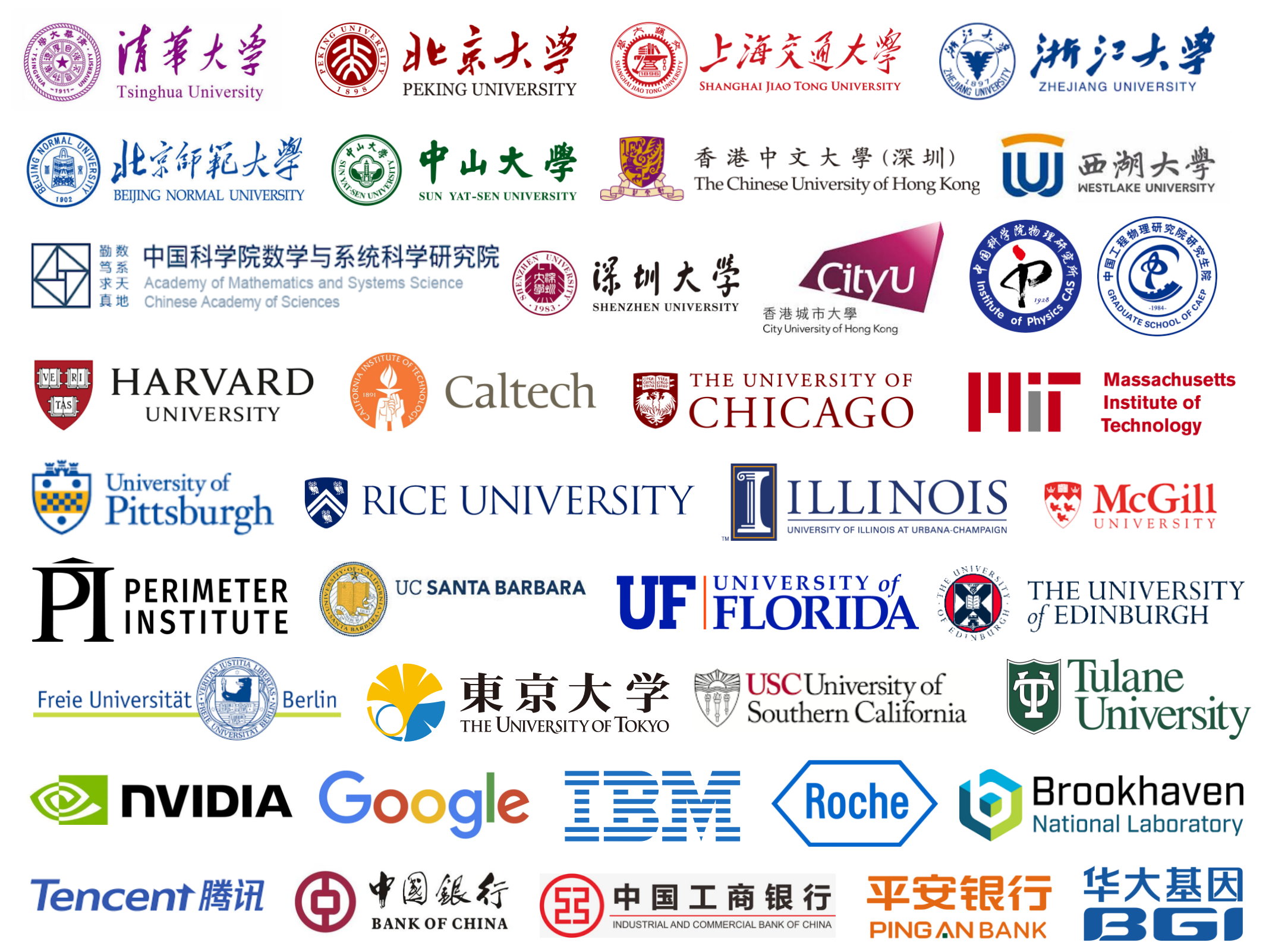
Trusted by Leading Research Labs and Corporate Partners

Collaborator & User Logos
Tencent Quantum Lab Tsinghua University Zhejiang University NVIDIA cuQuantum

Core Publications & Reference Material

Explore the underlying mathematics, software architectures, and validation methodologies of TensorCircuit-NG.

arXiv Pre-print (2026)

TensorCircuit-NG: A Universal, Composable, and Scalable Platform for Quantum Computing and Quantum Simulation

S.X. Zhang, Y.Q. Chen, et al. Detail of multi-node GPU scaling, stabilizer/qudit simulation features, and compilation pipelines.

Read on arXiv
Quantum Journal (2023)

TensorCircuit: a Quantum Software Framework for the NISQ Era

Published peer-reviewed study laying down the mathematical architecture of automatic differentiation and tensor-network simulation.

Read Paper

TensorCircuit-NG: 下一代科研基础设施

"When promotional claims begin to align, how do you judge if a quantum-classical platform is mature and ready for production? Authentic infrastructure is built on five checkable dimensions: Openness, Benchmarks, Academic citation, Industry applications, and Continuous architectural iteration."

  • 真正的可信度来自第三方用户能够独立运行代码、检查实现、复现实验和构建自己的工作流,代码本身永远比宣传材料更诚实。
  • 在 TC-NG 架构中,Quantum Circuit、Neural Network、Tensor Network 被纳入统一计算图,将 CPU、GPU、HPC 和 QPU 编排为统一算力。
Read Full Infrastructure Blog
Shixin Zhang
Shi-Xin Zhang
Platform Founder & Core Maintainer

Lead Author of TensorCircuit-NG, researching high performance quantum software, machine learning, and quantum many-body physics.

Build the Future of
Quantum Compute

We welcome thoughtful conversations with long-term technology partners, including venture capital firms, enterprise computing groups, hyper-scale cloud providers, and academic labs interested in quantum software infrastructure.

General Inquiries
shixinzhang@iphy.ac.cn
Open Source Collaboration
github.com/tensorcircuit/tensorcircuit-ng

This form opens your email client with a pre-filled draft. No message is stored or transmitted by this page.

 VC Context: We are open to discussing the technical roadmap, market landscape, ecosystem moat, and commercialization paths when there is a strong long-term fit.
 Enterprise Context: Let's address custom pipeline licensing, hardware integration, and proprietary model training solutions.
 HPC Context: We can share benchmarks for multi-node multi-GPU clusters, Slurm resource allocation, and cloud APIs.
 Researcher Context: Ask about paper reproduction pipelines, special backend features, or community-sponsored PRs.